

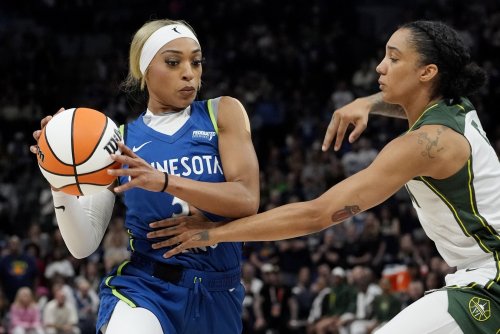
With 8:08 to go in the second quarter of Monday’s game against the Dallas Wings, DiJonai Carrington frantically began looking in front of the Minnesota Lynx bench for a contact that had fallen out on the previous offensive possession.
After finding the contact, she looked off Lynx trainer Chuck Barta, who had rushed to her aid with a bottle of cleaning solution for the lens. Instead, Carrington, with no mirror, peeled her eyelids apart and popped the contact back in, with no solution.
Jon Krawczynski detailed his reaction to this act of toughness after the game on The Missing Lynx live podcast.
"We’ve seen Willis Reed walk out of the Madison Square tunnel dragging one leg," Krawczynski said. "We’ve seen all sorts of different toughness, but that's not tough. That’s crazy."
“She is built different, that is for sure, to be able to do something like that.”
A few plays later, Carrington motioned to the bench for a substitution and headed back to the locker room. She wouldn’t join her teammates after halftime, and eventually, the Lynx gave an injury update.
She would miss the rest of the game with a left shoulder injury.
Cheryl Reeve offered further clarification after the game. “Nai has a subluxed shoulder,” Reeve said.
“She told me she played defense too hard,” Reeve added with her trademark sarcasm. “I think when she slapped down at the ball, it kind of subluxed a little bit. … I just know this is something she deals with.”
For most Lynx fans, this was the first time hearing about the left shoulder being a problem. Carrington had been playing most of the season with tape on her right shoulder, but the left had seemingly been healthy.
Given this news, it’s essential to understand what a subluxation is and how someone with Carrington's level of toughness has been able to “deal with” all season.
In the case of a subluxed left shoulder, like Carrington’s, the ball at the top of the humerus (upper arm bone) is ripped from its normal location inside the socket and almost fully dislocates. However, it slides to the end of the socket and stops. In some cases, it resets itself naturally, and in others, it may need therapy or medical help to reset.
The experience is quite painful. Tendons and muscles get stretched, and the ligaments holding the shoulder in the socket get torn or damaged. After the immediate sharp pain, the shoulder may feel weak or described as “not right.” Since it’s technically not fully dislocated, the arm doesn’t just hang. Instead, it feels out of place.
Swelling and more chronic pain begin in the hours to days following, promoting the use of every medical professional's favorite acronym, RICE (Rest, Ice, Compression, Elevation). It’s important to rest the shoulder to allow the ligaments and connective tissue to heal. Therefore, it’s not uncommon to see people wear a sling for weeks to stabilize the shoulder. Ice is used to decrease inflammation, and compression, in the form of ACE wraps, helps push blood flow back to the core. In the rare case, elevation often gets excused due to the shoulder being above the heart.
After a few days to weeks, the injury often heals. However, as is likely the case for Carrington, the injury drastically increases the chances of it happening again, as the tendons and ligaments holding the shoulder get stretched with every dislocation.
Think about this like holding together a deck of cards with a rubber band. Each time you peel off the rubber band to play some good old-fashioned crazy rummy with your grandmother (RIP Doris), the band gets looser. Eventually, you may have to twist it over the cards three or four times before it will actually hold the cards together.
Tendons and ligaments are similar. Due to their poor blood flow, they don’t have the same ability to regain their shape and strength as fast as muscles. That often leads to the injury recurring frequently, making it more challenging to recover fully from it.
Fortunately, the injury doesn’t pose a lot of short-term damage, as the shoulder resets. However, the risk for arthritis later in life and the risk of another subluxation or dislocation increase with each occurrence.
The solution involves surgery in which an orthopedic surgeon goes in and manually (robotically, technically) tightens and repairs the damaged connective tissues to help secure the arm back in the shoulder socket.
This surgery is pretty routine in baseball and football, and even in basketball, but requires more time off than gritting through the subluxations. Medically speaking, the surgery is safe to put off due to the low risk of long-term damage.
That’s the challenge for Carrington. Likely, the fix to the problem would require surgery. However, the playoffs are around the corner, and rest and strengthening the shoulder in hopes that it doesn’t happen again is the more likely scenario. That may come with more pain and more discomfort.
The decision will ultimately come from Carrington and the staff. Still, the one thing we do know for sure is Carrington is built different.
Think you could write a story like this? Hockey Wilderness wants you to develop your voice, find an audience, and we'll pay you to do it. Just fill out this form.
Recommended Comments
There are no comments to display.