
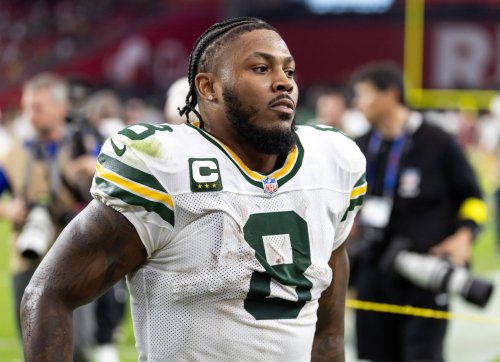
Josh Jacobs brought a much-needed physical presence to the Green Bay Packers’ backfield when he arrived in Titletown in 2024, giving the offense a tone-setter who can handle volume and create tough yards between the tackles. That impact shouldn’t be overlooked, but his long-term future in Green Bay isn’t as clear.
Josh Jacobs will turn 29 just days after the 2026 season ends, and his $16.6 million cap hit in 2027 becomes a significant factor, especially if no restructure or pay cut is in place. For a team that has consistently emphasized roster flexibility, that combination of age and financial commitment naturally raises questions about his future.
How the Packers approach the running back position in the draft could say a lot about how they view Jacobs’ future. Right now, he’s the No. 1 option, but the depth behind him doesn’t show much promise.
MarShawn Lloyd hasn’t shown he can stay healthy consistently, or much at all. While Chris Brooks is a serviceable third option who brings value as a blocker, he doesn’t offer much beyond that. The timing matters, and if Brian Gutekunst invests in a running back early, it could be a sign the team is already thinking about what comes next.
Moreover, Green Bay will have some decisions to make over the next couple of years. Tucker Kraft looks like a strong candidate to get paid. Jayden Reed, Evan Williams, and Javon Bullard could all build legitimate cases for second contracts. Edgerrin Cooper could also put himself on track for an early extension if he puts together a Pro Bowl-level campaign.
It wouldn’t be surprising if the Packers aim to keep at least two of those players. On paper, they’re in a good spot, with over $67 million in projected cap space for 2027, but that number can be misleading. As the cap continues to inflate, so do player demands and market values. That means Brian Gutekunst will need to stay ahead of it and keep as much flexibility as possible to retain his core while still managing the roster long term.
The Packers also need to evaluate Jacobs’ progress and whether he’s starting to follow the usual curve we see with running backs as they get older. The raw numbers don’t tell the full story. He finished with 929 rushing yards last season, the third-lowest total of his career, but he was still creating a lot on his own, averaging 3.6 yards after contact per attempt, the 29th highest among 65 running backs with at least 50 rushing attempts.
The context matters here. Green Bay’s offensive line ranked 19th in run-block win rate, which is middle of the pack, and there were plenty of snaps where Jacobs had to make something out of very little. The blocking wasn’t consistently there, and that’s clearly part of the reason his production looks underwhelming at first glance.
The first step for Green Bay is simple: They need to block better for Josh Jacobs. If the offensive line holds up and Jacobs still shows signs of decline, then keeping him in 2027 at that number becomes a tough sell. They could always discuss a pay cut, but that’s not something you often see in the NFL. And from Jacobs’ side, there’s little reason to take less if there’s a chance he could get more on the open market.
It’s tough to come to any firm conclusion this offseason, but it’s hard to see No. 8 being back in Titletown next year at those current numbers. If he puts together an All-Pro type of season, that could obviously change the conversation. However, as things stand right now, his future in Green Bay feels far from certain. The draft may shed a little more light on it.
Think you could write a story like this? Hockey Wilderness wants you to develop your voice, find an audience, and we'll pay you to do it. Just fill out this form.
Recommended Comments
There are no comments to display.